Over the next few posts, I plan on doing something a little different. We shall be having a look at various planets, starting with those in our solar system, but instead of me writing loads of stuff for you, I shall be making some little factfile cards to share!
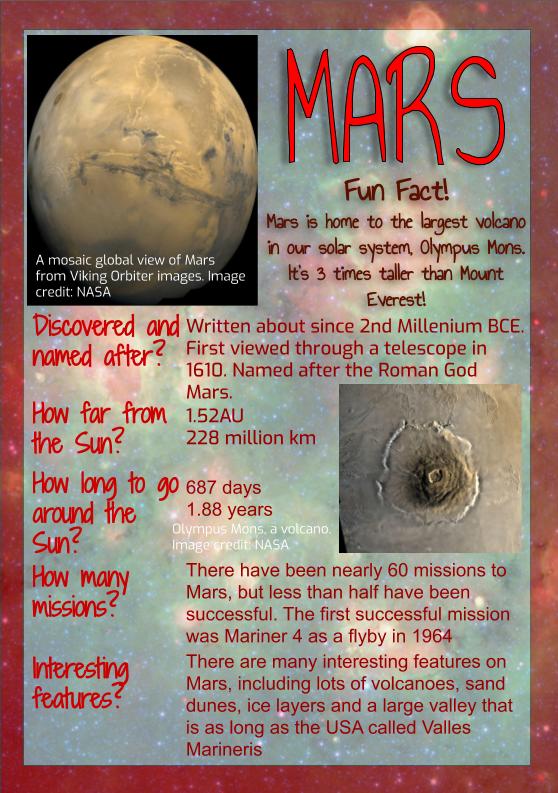
For our next planet, we skip Earth (I’m hoping you know a few things about Earth and maybe we shall visit Earth later) and head straight to the red planet, Mars.
Mars
More cards! Gotta do something with all this extra time most of us seem to have now. There is so much information on Mars that I couldn’t possibly put it all into one card for you; that would be information overload!
Fun extra fact for you: the picture at the top of my website is actually a solar eclipse from Mars! One of Mars’s moons, Phobos passed across the Sun and the Curiosity Rover snapped those images. It’s one of my favourite sets of photos because I always loved solar eclipses, and the first time I realised other planets had them too made space feel a little bit closer.
Hopefully you are all doing ok in this time of unrest. I’ve got plenty more time now, so updates and content will be coming at you quicker than normal. If anyone needs to talk about anything, whether it be space, current climate, or if you’re just feeling down, don’t hesitate to reach out. We all need each other in this tumultuous time.
Over the next few posts, I plan on doing something a little different. We shall be having a look at various planets, starting with those in our solar system, but instead of me writing loads of stuff for you, I shall be making some little factfile cards to share!
Next planet from the Sun is Venus, so let’s take a closer look at this mysterious planet!
Venus
A second card for you to add to the collection. I am currently wokring on making “backs” of these cards with more details and more numbers for those interested in things like aphelion and azimuths!
Over the next few posts, I plan on doing something a little different. We shall be having a look at various planets, starting with those in our solar system, but instead of me writing loads of stuff for you, I shall be making some little factfile cards to share!
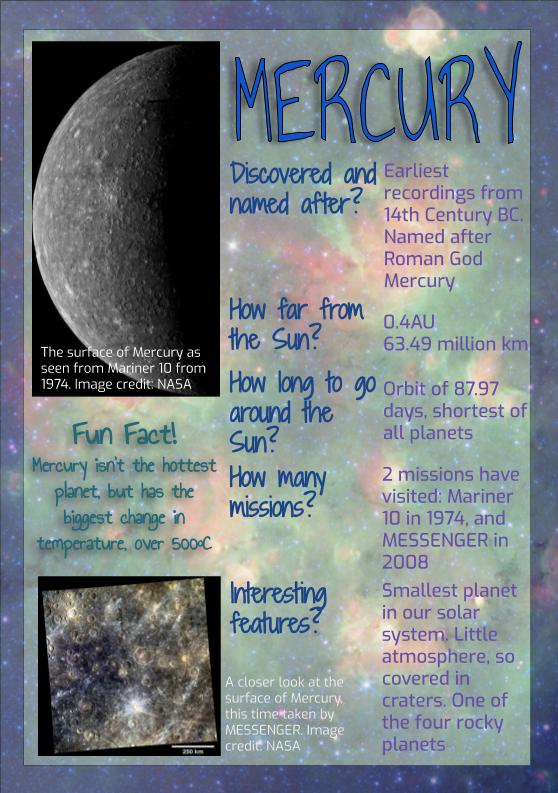
So to start with, here is Mercury! As always, feel free to comment any questions. I’ll do my best to answer!
Mercury
The first card in the set. Check back to see the rest of the collection!
Hey all. Me again answering more questions about the Sun. In this post, I am actually going to be answering a few all together in one answer, as they are very similar and it happens to be one of my favourite things I ever learnt about. So, without further ado, let’s find out the questions we are answering!
Another picture I took in Blackpool. The classic donkeys on the beach. Credit: Me
How was the Sun created?
To learn how the Sun was created, we need to head way back in time. Way before the Sun was even a Sun. Way back even before our galaxy was made! This means heading back over 13.51 billion years. A very long time ago.
At this point, the area of space we currently lived in looked very different. There were no stars, no planets, no suns. All that was there was a big pile of dust and gas. Not very impressive so far. But then something happened. We don’t really know what happened, but something did. It made all the gas and dust spin and hit into each other. It all crashed around and made our galaxy. A very good visual example of this is this video by the Slow Mo Guys, Gav and Dan. Watch the video, then come back here!
In the video, the Slow Mo Guys get a foam ball filled with water and spin it around. Not only does it look cool, but Gav is very right that it looks like a galaxy, because it was a very similar process that happened. The ball represents the black hole that’s in the middle of the galaxy, and all the water being flown about it is all the stars and gas and dust. What happens next is where we start answering our question.
A galaxy in our neighbourhood called the Whirlpool Galaxy. A very similar galaxy to our own Milky Way. You can see some arms, which show how the gas and dust spin around. Credit: NASA
So, now the galaxy has formed and there is alot of gas and dust floating around and spinning around a black hole. Sometimes, this gas and dust clumps together and starts hitting each other. This was case with our solar system. There was a lot of gas and dust spinning around itself, when something big came along and gave it a nudge. All the gas and dust started colliding and hitting each other, setting off chain reactions. Gas collected together and started something called ‘nucelar fusion’. This is what started the Sun. All the dust started joining together to make the planets and moons and other things in our solar system. This all happened 4.6 billion years ago, so a long time ago, but not as long as the start of the galaxy. It takes a long time for things in space to happen!
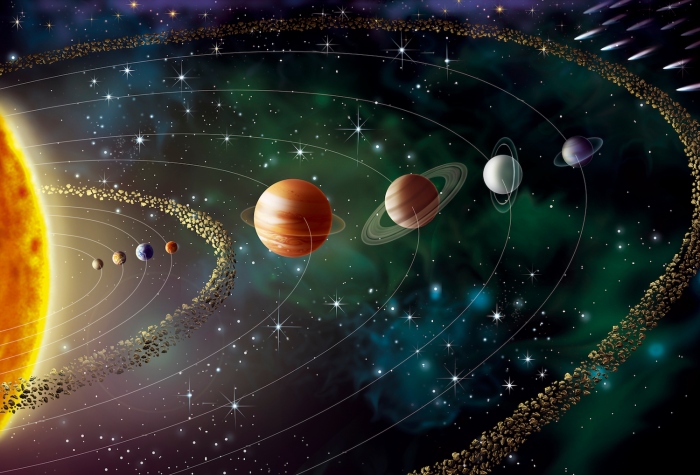
An artists impression (not to scale) of our Solar System, including asteroid belts. Credit: AAS Nova
So now we have our solar system making itself. It is still really chaotic though, with big planets and small planets crashing about. Fairly quickly though, things start calming down and we start to see the solar system we know today. Then, 4.54 billion years ago, life starts happening on Earth. It still takes a long time before we start to see humans, but things are happening on our planet. When humans did start arriving, they were looking up into the sky constantly. It has always been interesting to see the night sky, because it is so different and always looks like it’s changing to us.
We can now move onto another question asked, which was who named all the planets? This is a really easy question to answer, because normally it is the person who discovered the planet who names them. Why they named them with some strange names is a mystery though. The closest planets (Mercury, Venus, Mars and Jupiter) to us have been known about and tracked for a very long time, because they are bright enough that we can see them clearly in the sky with no help from a telescope. So they have been known about every since humans have tracked the night sky. They may not have understood what these planets were, but they knew how they moved and named them.
The first planet to be “discovered” was Uranus, by Sir William Herschel in 1781. This was the first planet that needed a telescope to be seen. Next to be discovered was Neptune in 1846. Further away so needed a better telescope to be abelt o see and observe this planet. Pluto (which is argued both to be a planet and not a planet) was discovered in 1930. It was only in 2006 that Pluto was demoted to a dwarf planet, but we love it all the same!
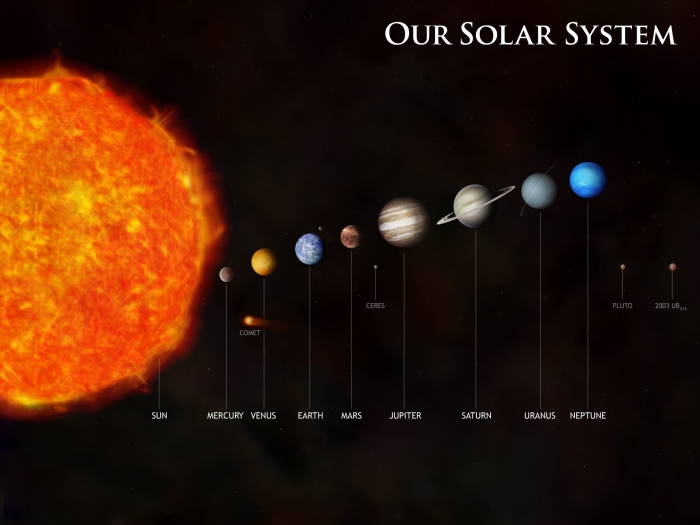
Our solar system is made up of a star—the Sun—eight planets, 146 moons, a bunch of comets, asteroids and space rocks, ice, and several dwarf planets, such as Pluto. Credit: NASA Solar System Exploration
So there we go, a couple of question answered about the Sun and how it and the planet was made. There is sooooo much more deatil I can go into about how everything was formed and what it is made of, but that is perhaps for another day and more complex post.
In the meanwhile, if anyone has any questions about anything to do with space, please do pop them down and let me know! I could create a post just for you! Also, feel free to follow me on Twitter. Spacelabh has its own Twitter page now, so you can stay up to date with new posts and other fun and current information about space. I also have a personal Twitter account you are more than welcome to follow, which includes space, gaming and other random tweets. Thank you all and see you next time!
Hello everyone! I am still in Sun mode from work and recently stumbled across some questions about the Sun that people wanted answered. Some of these questions were amazing and I really wanted to answer them. I won’t be able to answer them all in one post. So joy of joys! Multiple things to read! So, here are some questions about the sun that I really enjoyed and wanted to answer!!
A sunset over Blackpool beach that I took on a day trip.
How far away is the Sun?
There were a couple of similar questions to this, including “how far up is the Sun?”. This can be a really easy question to answer, as we can really accurately measure it. But it can also be really difficult, as the Earth doesn’t go around the Sun in a perfect circle, so the distance changes. The average distance between the Earth and the Sun in 149.6 km away. The furthest away the Earth gets from the Sun is 152.6 km away, and the minimum distance is 147.5 km.
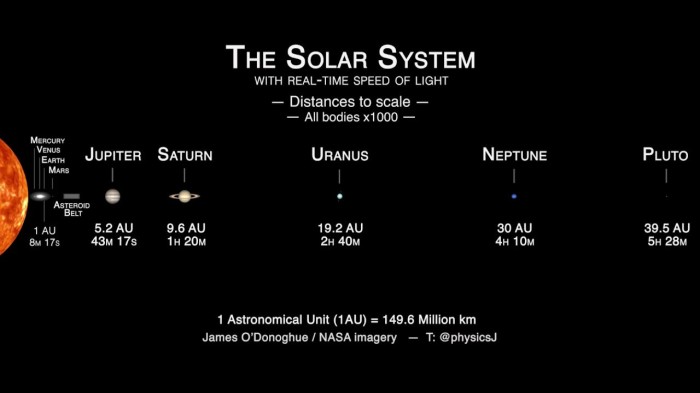
In astrophysics, we change the average distance from kilometers to something called “astronomical units”. 1 AU is 149.6 km. This makes it easier to compare distances. Instead of having really big numbers describing distances, we can use smaller numbers and compare the distances to Earth. For example, Jupiter is an average 778.5 km away from the Sun, which is a very big number. But if we change this into astronomical units, the number becomes 5.2AU, a much smaller number. This also tells us that Jupiter is just over 5 times further away from the Sun than the Earth is.
An image showing the distances of the planets in astronomical units. This image also shows how long it would take light from the Sun would take to reach each planet. Image credit: NASA Imagery
How big is the Sun in cm?
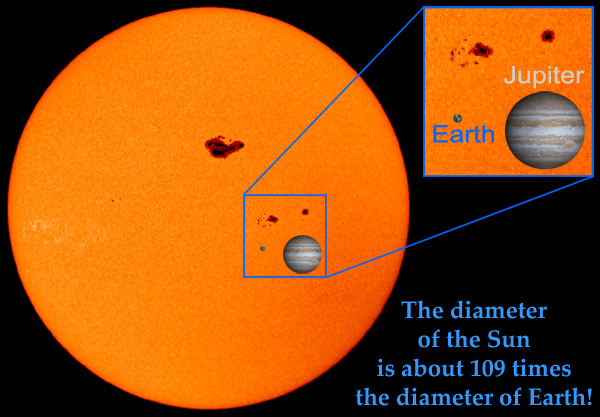
This is a very good question. The Sun is big. Very big. In centimeters, the Sun’s diameter is 139.1 billion cm. That is a lot of cm!! And that is just across the middle of the Sun. If we were to use this number to see how big the Sun is, how much space it takes up, we would get 1.409×10^33 cm^3. This is a very big number and a very strange way to write numbers. The part at the end, x10^33 means you need to move the decimal point 21 times to the right. That means the number becomes 1,409,000,000,000,000,000,000,000,000,000,000. Wow. That is a huge number, especially in cm!! Another way of looking at this would be to think how many Earths would fit inside the Sun. The answer is 1.3 million Earths. That means 1.3 million of the planet we live on would fit inside the Sun. It would take 1,000 Jupiters, the biggest planet in our solar system, to fill up the Sun. Tremendous!
The Sun is about 109 times as large as Earth, in terms of diameter. This picture shows the Sun (with some sunspots), Jupiter, and Earth to scale. (Click image to enlarge)
Credit: Original artwork by Randy Russell. Sun image courtesy SOHO/ESA/NASA. Jupiter image courtesy NASA/JPL/University of Arizona.
Another question that I shall tag on with this one is “how many teachers will fit into the Sun?”. To answer this, we are going to assume that teachers are normal humans and therefore have the average volume of a human 0.063 m^3. If we do a lot of maths, we get 22 billion billion billion teachers that can fit in the sun. That is a lot of teachers! Who wants that many teachers giving you homework? Good news is though, that there are only 7.7 million people on the Earth right now, so even if we put every person in the Sun, we wouldn’t fill it very much.
Is there a bigger Sun?
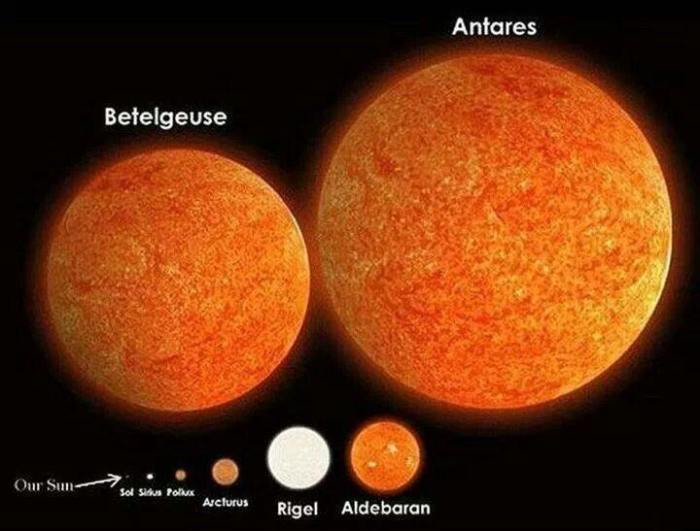
This seems like a good question to answer after the previous one. We have just discovered that our Sun is very big compared to the Earth. However, the Sun is actually very small in terms of other stars. There are lots of stars, even in our galaxy, that are much, much bigger than our own. Below is a picture that shows some of the bigger stars and how small our Sun actually is.
Even though our sun is big to us, it is actually really small compared to other stars, even in our galaxy! Image credit: Quora
In this picture, our Sun is very very small. Lots of stars are much bigger than it. And all these stars are some that we can see from Earth. In fact, lots of people can easily spot Betelguese in winter because it makes up part of the constellation Orion. Many people can spot the 3 stars that make up the belt of Orion and just above these is the star of Betelgeuse. This star is so much bigger than the Sun, it’s diameter is about 700 times that of the Sun, meaning it’s volume is way bigger. That is a very big star. And this is a star is one that we are constantly watching because it could be very close to going supernova (exploding). If it did, it is an explosion that we would be able to see from Earth, and it could be so bright that we might be able to see it during the day time!
The Orion constellation is one of the most famous constellations, with many people being able to spot the 3 stars making the belt of Orion in the winter sky. The bright orange star in the top left conrer of the right picture is the star Betelgeuse. Image credit: The Express online
So there we go, 3 questions answered! More on the way, including questions like “who named all the planets?” and “would the Sun one day explode?”. Lots of good questions to look forward to and some that can get really complicated with lots of hard maths (like hydrostatic equilibrium!). Please do join me again, and if anyone has any more questions about the Sun, please do drop me a comment and I shall do my best to answer them!







 spacelabh.com